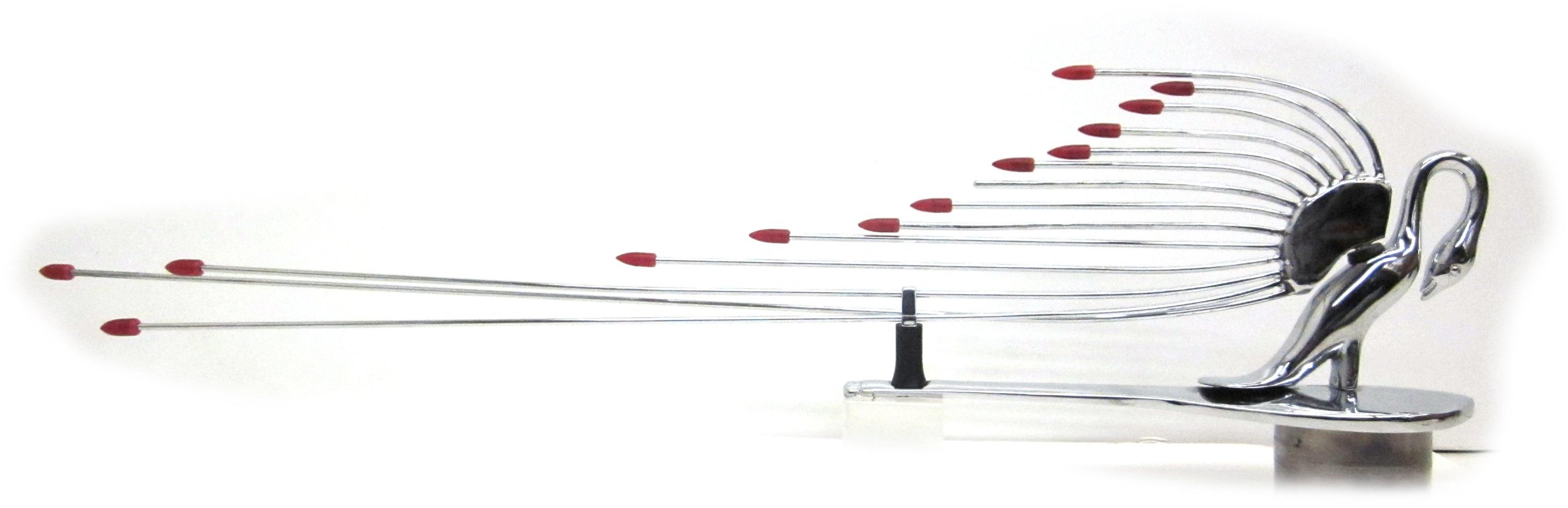
优雅与风格:派卡德车标与引擎盖装饰
Grace and Style: Packard Mascots and Hood Ornaments
什么是车标与引擎盖装饰,它们有何区别?
What are Mascots and Hood Ornaments, and What is the Difference?
“引擎盖装饰”(hood ornament)是安装在汽车前部、通常位于引擎盖上的装饰件;“车标”(mascot)则是代表某个团体或品牌的象征性形象。严格来说,只要人们能将某个引擎盖装饰与特定品牌对应,它就属于车标。如今,mascot 与 hood ornament 常被交替使用。为便于阅读,本文统一使用“车标”这个术语。
A “hood ornament” is a decorative piece placed on the front of a car, typically on the hood, while a “mascot” is a symbolic character representing a group or brand. Technically, if anyone can identify a hood ornament with a specific brand, it is a mascot. Today, mascot and hood ornament are used interchangeably, and for the ease of use, this page will use the term mascot.
早期车主依赖 Boyce MotoMeter(如图所示)——安装在散热器顶部、从引擎盖外伸出的温度计——来监控发动机冷却液温度。各家车厂以授权方式生产 MotoMeter,并加上自家品牌的车标。到了 1930 年代,散热器盖被移到引擎盖下,仪表盘也提供了温度显示,功能性的车标不再必要,逐渐转为纯装饰。
Early motorists relied on Boyce MotoMeters (like the one pictured here), a thermometer device mounted on the top of the radiator, which itself stuck out of the hood, to monitor engine coolant temperature. Car manufacturers license-built MotoMeters and added their own branding with mascots. By the 1930s, radiator caps were placed under the hood and dash gauges showed temperatures, rendering functional mascots obsolete, and they became completely decorative.

数字 6(Figure 6)
The Figure 6
1911 年,派卡德希望将四缸车型与六缸车型区分开来。公司总裁亨利·B·乔伊被认为设计了“数字 6”车标,并在 1911 年 12 月 27 日的《Horseless Age》杂志上进行宣传。派卡德当时的广告很快把“Figure Six”称作“Dominant Six”。1917 年,“Double-Six”车标则代表新的 Twin Six 车型。
In 1911, Packard wanted to distinguish the four-cylinder cars from its six-cylinder cars. Company President Henry B. Joy is credited with designing the Figure Six mascot, and advertised it in the December 27, 1911 issue of Horseless Age magazine. Packard’s advertising of the period quicked dubbed the “Figure Six” as the “Dominant Six.” In 1917, the Double-Six mascot represented the new Twin Six models.

派卡德 MotoMeter
Packard MotoMeter
派卡德在 1912 至 1928 年间生产了经授权的 Boyce MotoMeter,至少有五种样式。图示这种纤细的垂直款用于六缸车型,较厚的款式用于八缸和 Twin Six。
Packard built licensed Boyce MotoMeters from 1912 to 1928, in at least five styles. Thin vertical models, like this one, were for the Sixes, and a thicker model was for the Eights and Twin Sixes.

箍形散热器盖(Bail Cap)
The Bail Cap
1929 年,派卡德停止使用 MotoMeter,改用带有凸起肋条和箍形钢丝的简易散热器盖。钢丝用于压住散热器盖,盖子后部带铰链。该“箍形盖”一直具有功能性,直至 1932 年。
In 1929, Packard stopped using MotoMeters, and replaced them with a simple radiator cap furnished with a raised rib and bale wire. The wire held down the radiator cap which was hinged at the rear. The bail cap was functional until 1932.

速度女神(Goddess of Speed)
The Goddess of Speed
速度女神由约瑟夫·E·科克尔(Joseph E. Corker)设计,派卡德在 1926 至 1950 年间采用。其形象源自希腊神话中的胜利女神 Nike(驾驶战车),但“女神”在不同时期呈现多种风格变化。派卡德在 1926–1937 年采用最初版本;1937–1939 年使用沃纳·古比茨(Werner Gubitz)设计的新版本;1939–1942 年采用约翰·D·威尔逊(John D. Wilson)的第三版;1946–1950 年则为霍华德·耶格尔(Howard Yeager)设计的全新风格化版本。
Joseph E. Corker designed the Goddess of Speed, which was used on Packards from 1926 to 1950. The figure is based on Nike, the Greek divinty who drove a chariot but the Goddess went through a variety of stylistic changes. Packard used the original Goddess of Speed from 1926-1937. Packard used a new Goddess, designed by Werner Gubitz, from 1937-1939. A third Goddess, designed by John D. Wilson used from 1939-1942. A new sylylized Goddess, designed by Hooward Yeager, was on the 1946-1950 cars.

阿多尼斯(Adonis)
Adonis
阿多尼斯由爱德华·麦卡滕(Edward McCarten)设计,派卡德在第六至第十系列(1929–1932 年)使用。其他非官方名称包括 Daphne 与 Sliding Boy。与流行的误解相反,它并非法国设计,也并不代表一位少女。
Edward McCarten designed Adonis and Packard used it from 1929-1932 on the Sixth through Tenth Series. Other unofficial names include Daphne and Sliding Boy. Contrary to popular myth, it was not designed in France nor represents a young girl.

鹈鹕……还是鸬鹚?
Pelican… or Cormorant
派卡德车标中最著名的当属“鹈鹕”。该名称首次用于 1932 年的第九系列,专供 Super Eight、Twelve 与高级派卡德车型。“鹈鹕”源于派卡德家族徽章上的鸟。1938 年,派卡德广告部门认为“Cormorant(鸬鹚)”听起来更庄重,于是改名,这引发了偏好“鹈鹕”的客户大量投诉。最终在 1949 年,派卡德发布备忘录,正式确认名称为“鹈鹕”。
The most famous of the Packard mascots is the Pelican. That was the named assigned to this mascot when Packard introduced it in 1932 on the Ninth Series, reserved for the Super Eights, Twelves, and Senior Packards. The Pelican was a tribute to the bird on the Packard family crest. In 1938, Packard’s advertising department decided that Cormorant sounded more dignified name than Pelican, unleashing a number of complaints from customers who preferred Pelican. Finally, in 1949, Packard issued a memorandum stating the name was officially Pelican.

在所有派卡德车标中,最为罕见且最为惊艳的是带“无线电天线”特殊附件的鹈鹕,用于第十六与第十七系列车型。
Among the rarest and most spectacular of all Packard mascots is the Pelican with special radio antenna accessory, used on the Sixteenth and Seventeenth Series cars.
欲了解更完整的信息,可参见 Beverly Kimes,《A History of the Motor Car and the Company》,第 754–773 页。
For more complete information, see Beverly Kimes, A History of the Motor Car and the Company, pages 754-773.